Texas Weather That Changed Roofing, Part 1
Updated: Aug 31
The Great Galveston Hurricane of 1900

When Texans think of destructive weather, they often picture baseball-sized hail, powerful tornadoes, or the devastation left behind by Hurricane Harvey. But more than a century before Harvey flooded Houston and long before modern weather satellites tracked storms across the Gulf of Mexico, one hurricane forever changed the way Texans build homes, design roofs, and insure property.
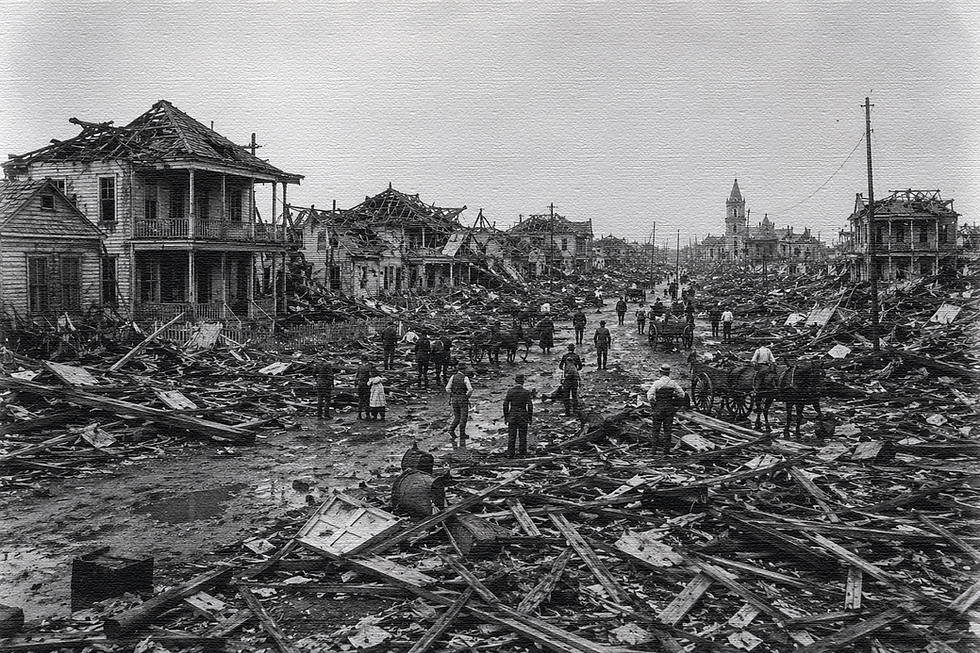
On September 8, 1900, the Great Galveston Hurricane slammed into the Texas coast with little warning. By the time the winds subsided and the floodwaters receded, an estimated 6,000 to 8,000 people had lost their lives, making it the deadliest natural disaster in American history. Entire neighborhoods disappeared. Thousands of buildings were destroyed. The storm reshaped not only the city of Galveston, but also the future of construction throughout Texas.
While today's roofing systems are designed with decades of engineering research behind them, many of those lessons were learned through tragedies like this one.
A Thriving City That Thought It Was Safe
At the turn of the twentieth century, Galveston was one of the wealthiest cities in Texas. Its busy port handled trade from around the world, elegant Victorian homes lined the streets, and many believed the island was destined to become the largest city on the Gulf Coast. But there was one problem: much of the city sat only a few feet above sea level, protected by little more than sand dunes and optimism.
Although hurricanes had struck the Gulf Coast before, many residents believed a storm powerful enough to destroy Galveston simply wasn't possible. Weather forecasting was still in its infancy, and communication was limited. Without radar, satellites, or modern forecasting models, communities often had only hours—or less—to prepare.
When the hurricane arrived, it brought more than violent winds. It pushed an enormous wall of seawater onto the island, lifting homes from their foundations and sweeping entire blocks into the bay.
How Homes Were Built in 1900
To understand why the destruction was so widespread, it helps to understand how buildings were constructed at the time. Many homes featured beautiful craftsmanship, but they lacked the structural connections that modern builders now take for granted.
Common characteristics included:
Wood framing fastened with relatively simple joinery
Minimal anchoring between the roof, walls, and foundation
Shallow foundations resting on unstable coastal soils
Wood shake or early composition roofing materials
Limited understanding of wind uplift forces
Builders certainly knew how to construct attractive homes. What they didn't yet understand was how hurricane-force winds behave.
Today, engineers know that wind doesn't simply push against a building. As air flows over a roof, it creates suction that can literally pull the roof upward. Once the roof fails, the rest of the structure often follows quickly. Those principles siimply weren't well understood in 1900.
The Roof Is Often the First Line of Defense
One of the most important lessons reinforced by the Galveston Hurricane is something roofing professionals still teach today:
A roof is much more than the material you see from the street. The shingles, metal panels, or tiles are only the outer layer of a much larger structural system.
Modern roofing systems include:
Roof decking
Rafters or engineered trusses
Structural connectors
Underlayment
Flashing
Fasteners designed for specific wind loads
Carefully engineered ventilation systems
If any one of those components fails during a major storm, the rest of the building becomes significantly more vulnerable.
This "roofing system" approach didn't develop overnight, but disasters like Galveston accelerated the industry's understanding of just how important every connection really is.
The Birth of Better Coastal Construction
In the years following the hurricane, Galveston undertook one of the most ambitious engineering projects in American history. Workers constructed the famous Galveston Seawall, eventually extending it for miles along the coastline. At the same time, much of the city itself was physically raised—some neighborhoods by as much as seventeen feet—using millions of cubic yards of sand pumped beneath existing buildings.
Construction practices evolved as well. Builders began placing greater emphasis on:
Stronger foundations
Better structural connections
Improved resistance to wind uplift
More durable exterior materials
Elevated construction in flood-prone areas
Many of these ideas would eventually spread far beyond Galveston, influencing coastal construction throughout Texas and the Gulf Coast.
Insurance Changed Alongside Construction
The insurance industry learned difficult lessons from the storm as well.
Companies suddenly had an enormous amount of real-world data showing which buildings survived, which failed, and why.
Over time, insurers began paying much closer attention to factors such as:
Construction type
Roof material
Distance from the coast
Wind exposure
Flood risk
Building elevation
Those concepts are still reflected in many insurance policies today.
While homeowners often focus on the replacement cost of a roof, insurance companies also view the roof as one of the building's most important protective systems. A stronger roof can reduce the likelihood of widespread interior damage, making it one of the most valuable investments a property owner can make.
What We Know Today
Modern Texans benefit from more than a century of engineering research.
Today's roofing systems can include:
High-wind-rated asphalt shingles
Standing-seam metal roofing
Stone-coated steel roofing
Impact-resistant materials
Advanced synthetic underlayments
Hurricane clips and structural connectors
Improved attic ventilation
Better fastening schedules
Modern building codes developed through decades of testing and observation
No building can be made completely storm-proof. Nature has a way of humbling even our best engineering.
But today's homes and commercial buildings are generally far better equipped to withstand severe weather than those standing on Galveston Island in 1900.

Looking Back to Build Better
The Great Galveston Hurricane remains one of the darkest chapters in Texas history, but it also marked the beginning of a new era in construction. Every stronger roof connection, improved fastening method, elevated foundation, and modern wind-resistant roofing system reflects lessons learned from storms like this one.
History reminds us that building practices are never static. Every generation learns from the one before it, adapting to new materials, better engineering, and a deeper understanding of the forces nature can unleash.
For homeowners and business owners alike, that's encouraging news. A roof installed today isn't simply the product of modern manufacturing—it's the result of more than a century of hard-earned experience.
Coming Next
Stay tuned to the blog! We'll soon travel forward a few decades to another historic Texas disaster and explore how it influenced flood control, construction practices, and the evolution of building standards across the Lone Star State.
And don't forget to check out our other articles in this weather series:


Comments